Google Reader is awesome and all, but man, their error messages are quite useless sometimes:
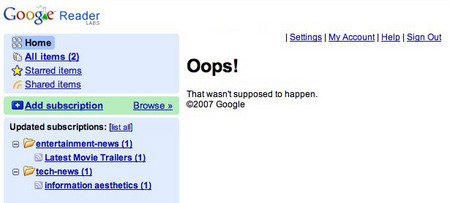

Google Reader is awesome and all, but man, their error messages are quite useless sometimes:
Posted in computing, funny, meaningless, tech
The hilarious headlines keep on coming. Kathryn found this one today:

It makes me wonder… if more people practiced birth control, would there be less cockfighting?
Kathryn’s parents live in Hilton Head, and came across this hilarious bit of local news:
Deputy finds man punching shrub
Published: Monday, January 22nd, 2007
A 23-year-old Hilton Head Island man was charged with public disorderly conduct after a deputy observed him ‘in a physical confrontation with shrubs’ at 8:27 p.m. Saturday at Carolina First, 401 William Hilton Parkway, according to a Beaufort County Sheriff’s Report.
Responding to a complaint that a man tried to get into a stranger’s car, a deputy called over to the suspect, who was punching vegetation. The man then ran across the bank parking lot to kick one last bush before talking to police, reports said.
He reportedly smelled of alcohol and was taken to the Beaufort County Detention Center, where he is being held for prosecution, according to the jail’s online log.
I have always suspected that there is something peculiar about the construction of the foul-tasting energy bars Kathryn is fond of buying:
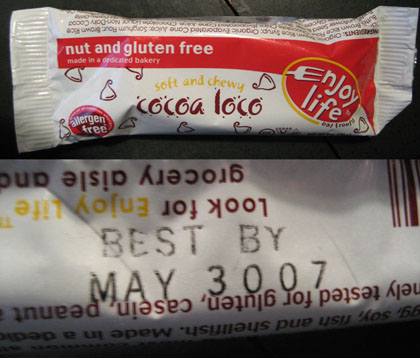
Lasting for one thousand years is an admirable feat. But I don’t think that will improve the flavor.
(My guess is it’s supposed to mean “May 30, 2007”.)
Through the Illinois Genetic Algorithms Laboratory blog, I learned of the Lemelson-Illinois Student Prize, a $30,000 award given to outstanding student inventors. The selection process for the prize is down to eight finalists, one of whom has created an amazing method to translate thoughts into speech:
Michael Callahan Graduate Student – Industrial and Enterprise Systems Engineering, College of Engineering
Michael hopes to assist individuals without the use of speech and mobility communicate through the application of neuroscience. By interfacing near the source of vocal production, he has been able to translate unspoken thought of the mind from intercepted neuronal activity at the vocal cords. The method that Michael has developed produces complete fluent speech with 70% accuracy from neurological signals.
Incredible. I can’t wait to see this kind of technology in use. It might complicate poker games, though.
Wow; I haven’t posted in a long time. I think this is because of the holidays, and because I’ve been spending a lot of time organizing and posting photos on Flickr. To see them, click here. If you haven’t already, click here to sign up for a free Flickr account (it’s even easier to do if you already have a Yahoo account). If I know you, let me know you’ve signed up for a Flickr account, and then I can add you to my Flickr contact list. This way, you’ll be able to see the additional non-public photos that are reserved for friends and family.
Posted in Uncategorized
Hilarious email from Christina:
========================
CHRISTMAS CAROLS FOR THE DISTURBED
* 1. Schizophrenia — Do You Hear What I Hear?
* 2. Multiple Personality Disorder — We Three Kings Disoriented Are
* 3. Dementia — I Think I’ll be Home for Christmas
* 4. Narcissistic — Hark the Herald Angels Sing About Me
* 5. Manic – Deck the Halls and Walls and House and Lawn and Streets and Stores and Office and Town and Cars and Buses and Trucks and Trees and…..
* 6. Paranoid — Santa Claus is Coming to Town to Get Me
* 7. Borderline Personality Disorder — Thoughts of Roasting on an Open Fire
* 8. Personality Disorder — You Better Watch Out, I’m Gonna Cry, I’m Gonna Pout, Maybe I’ll Tell You Why
* 9. Attention Deficit Disorder — Silent night, Holy oooh look at the Froggy – can I have a chocolate, why is France so far away?
* 10. Obsessive Compulsive Disorder — Jingle Bells, Jingle Bells, Jingle Bells, Jingle Bells, Jingle Bells, Jingle Bells, Jingle Bells, Jingle Bells, Jingle Bells, Jingle Bells, Jingle Bells, Jingle Bells, Jingle Bells, Jingle,Bells, Jingle Bells, Jingle Bells, Jingle Bells, Jingle Bells, Jingle Bells , Jingle Bells, Jingle Bells, Jingle Bells, Jingle Bells, Jingle Bells, Jingle Bells, Jingle Bells, Jingle Bells, Jingle Bells, Jingle Bells, Jingle Bells, Jingle Bells, Jingle Bells, Jingle Bells, Jingle Bells, Jingle Bells, Jingle Bells, Jingle Bells,
Today we received a holiday ham sent to us through Heavenly Ham by family members in Texas. The delivery guy handed me a small card with our family members’ greeting hand-written on it by somebody at HeavenlyHam.com. When I saw the following, I immediately recognized that the card was transcribed from a web-based form:
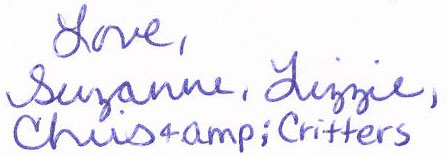
Yes, it says “Chris & Critters”.
An explanation for those of you that don’t speak HTML:
In HTML, if you want to write “Bob & Nancy”, you can’t just write the “&” directly, because it has a special meaning to HTML: it begins a character entity reference. In your HTML source, you have to write it as: “Bob & Nancy”. The browser will show this as “Bob & Nancy“. Well, someone at HeavenlyHam.com had the tedious task of hand-writing all the Web-form-submitted holiday greetings to include in the shipments of delicious goodies. This unlucky person didn’t translate the “&” back to “&“. Which amused me immensely, because I: 1) am a web developer, and 2) am easily amused.
Sweet Lord, my Genetic Algorithms course has ended. The giant pile of work is now behind me. I have to say that despite the large amount of work, the course has been one of the most rewarding in recent memory. There are a lot of exciting ideas in this field. The course instructor is David E. Goldberg, who is an influential luminary in the field.
For the course project, I decided to return to my decades-old interest in graphics programming by developing a genetic artwork program. The basic idea was to “breed” new images by figuring out which images in a random population are better than others. I needed a way to rank which images were better than others. Inspired by Flickr’s concept of interestingness, I decided to use color comparisons to popular images from Flickr.com as a way to rank images. An image that has a close match in color to a popular or interesting Flickr image is given a high rank. The genetic algorithm runs over successive generations to produce images with higher ranking. Eventually I got a lot of good results, and then a scary demon appeared:

The picture on the left is the Flickr image that the generated images resembled most. Lower numbers mean higher rankings. Look at 392. The demon got 4th place! Maybe that’s why he looks angry.
Here are some other interesting results I got with the demon’s paintbrush. Click to get to a more detailed writeup, including the many thousands of generated results:
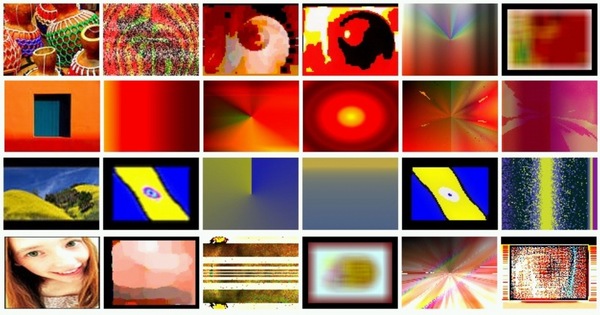
UPDATE: Click here to see some giant tiled montages of artwork generated by the technique.

Posted in Uncategorized